

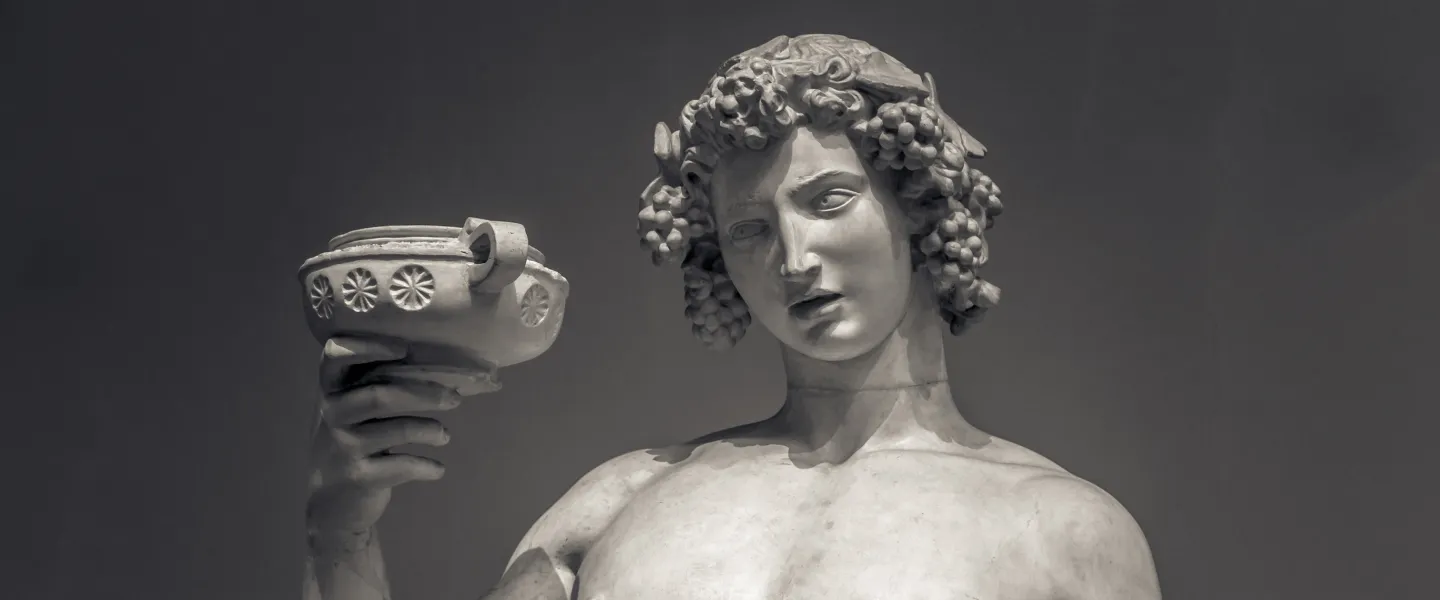
Regular visitors to the cinema over the past forty or fifty years might well have come across the most famous wine cup in history. Robert de Bresson’s Lancelot du Lac featured it in 1974. A year later it was the focus of much of Monty Python and the Holy Grail, although this iteration of the quest ends with King Arthur and his knights being arrested by some twentieth-century British police while the Grail’s resting place is protected by a vicious bunny rabbit. In 1981 the quest for this cup was central to John Boorman’s Excalibur and it has continued to feature in such films as Indiana Jones and the Last Crusade, The Fisher King and The Da Vinci Code.[1]
The wine cup in question is, of course, the Holy Grail, the legendary cup which Jesus is said to have drunk from at the Last Supper shortly before his arrest, crucifixion and resurrection. The concept of the Grail has fascinated people across the centuries. But as famous as the Holy Grail is, there is a resounding lack of detailed discussion about exactly what might have been in the cup and what it might have actually looked like. Here we examine the history of the Holy Grail and question what wine might have actually been served at the Last Supper.
So, for those who haven’t yet seen Monty Python’s doubtlessly historically accurate account of the Grail legend, let’s start by briefly asking what exactly is the Holy Grail? On a basic level the Holy Grail is the cup from which Jesus is purported to have drank wine at the Last Supper to celebrate the feast of Passover shortly before he was arrested by the Romans and Temple authorities, condemned to death and crucified. Having drank from the vessel Jesus instructed his Apostles to ‘Do this in memory of me’.
Thus, the Grail is intrinsically connected to the celebration of the Mass, one of the most central aspects of Christianity. Other sections of the Gospels also make the Grail the vessel into which Jesus’s blood poured while hanging on the cross as Joseph of Arimathea, the man who assumed responsibility for Christ’s burial after his death, held the cup below the cross.[2]
The myth of the Holy Grail holds that the cup was kept by Christ’s closest followers and guarded for centuries thereafter. It then ended up being taken to Europe, with different renditions of the tale surrounding it holding that it was taken to different countries at different times.
The vineyards of the Cremisan Winery near Bethlehem where wine is being made today from grape varietals such as Hamdani and Balouti which are native to Israel and which might have been used to make the wine served in the Holy Grail at the Last Supper
It was here in Christian Europe during the Middle Ages that it acquired its name, Grail being derived from the Old French or Occitan words graal, greal or grazal, meaning a cup or bowl. It was also during the Middle Ages that the idea emerged that the Grail was imbued with remarkable powers which could heal individuals who drank from it or make them eternally youthful.[3]
The Grail’s prominence in modern popular culture is directly owing to how it emerged as a central aspect of medieval literature between the twelfth and fifteenth centuries. At this time a series of tales were produced concerning the Grail, many of them tied into what is termed the Arthurian Cycle or the Matter of Britain, the collection of myths and fables associated with the legendary King Arthur and his Knights of the Round Table at Camelot.
The first of these major literary efforts concerning Arthur, his knights and the Holy Grail was produced by Chrétien de Troyes, a French poet who flourished in the second half of the twelfth century. In the late 1180s and early 1190s he composed Perceval, the Story of the Grail, an epic poem charting the life of Sir Perceval, one of King Arthur’s Knights of the Round Table, who was raised in the wilds of Wales.
He later ends up at Arthur’s court before setting out on his own adventures. During the course of these he ends up at the castle of the Fisher King where he discovers that the Grail is held there. Unfortunately, though, Chrétien appears to have died before he completed the poem and we do not know what he might have envisaged for it.[4]
Other works appeared on the Holy Grail and the Arthurian legend in the centuries that followed. A notable one was Joseph d’Arimathie by the early thirteenth-century French poet, Robert de Boron. Here de Boron hypothesised that Joseph of Arimathea had been visited by Jesus while he was in prison and that Christ explained the magical powers of the wine cup. Joseph was then said to have travelled far to the west to Britain where he became associated with Glastonbury and his ancestors were said to have become the guardians of the Grail for generations to come.[5]
Other versions of the Holy Grail legend in medieval literature tied Sir Lancelot du Lac and Sir Galahad, two of the other prominent Arthurian knights, to the Grail. This was the scenario favoured in perhaps the most famous of all Grail tales, La Morte d’Arthur composed by Sir Thomas Malory in England in the fifteenth century. But what is striking about all of these renderings of the Holy Grail is the singular lack of discussion of wine.
The cup itself is central to this medieval literature, but there is no overt discussion of what its contents might have been in the past or indeed what those who wished to be healed by drinking from it might have actually been drinking in doing so. But in order to try to cast some historic accuracy into this discussion we need to head all the way back to Judaea in the early first century AD.
If we were to ask what sort of wine might have once been served in the Holy Grail or what Jesus might have drank from it at the Last Supper, then surely we need to ask ourselves what kind of wine was being drank in Judaea in Roman times? The wine had been introduced to the Levant thousands of years before the time of Jesus and the Romans. By the classical period of Greek history, around the start of the Second Temple Period in Judaea, the common practice throughout the Eastern Mediterranean was to water wine down to the point where it was probably little more than 4%, 5% or 6% ABV.
This practice continued well into Roman times and so one of the things that we can speculate is that the wine drank at the Last Supper out of the fabled Holy Grail was substantially weaker than most modern wines. Yet this is not wholly clear and as we will see below there are some authorities on the matter who have speculated that the wine of the Last Supper was actually quite potent.
In addition to possibly being watered down, the wine consumed by Jesus and his Apostles was very likely to have been spiced. Winemakers at the time in the Levant believed that tree resins like frankincense, myrrh and terebinth prevented wine spoilage and so they added them to their product. These would have added spicy, bitter notes to the wine made here.
This would have been counterbalanced by the addition of some fruits like pomegranate and figs, while saffron and cinnamon were other possible additives. It is quite likely one or multiple of these ingredients would have been present in the wine Jesus drank from the Holy Grail two millennia ago, making it a spiced wine, possibly with some fruity notes.[6]

